
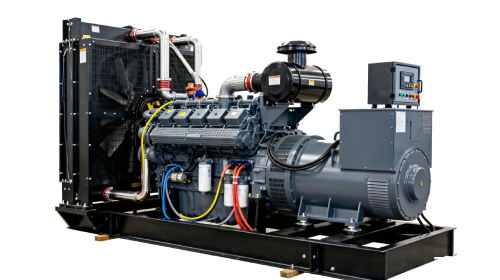
Ⅰ.Test Objectives
- Basic Compliance Verification: Confirm that the construction quality of the unit and auxiliary systems meets design specifications and is free of installation defects.
- Individual Unit Performance Compliance: Verify the unit’s steady-state output, transient response, alarm protection, and long-term load-bearing capacity to meet rated operating conditions.
- System Interconnection Reliability Assurance: Ensure the normal operation of the interconnection logic between the unit and the mains power, UPS, computer room load, and cooling system, and ensure stable power supply in the event of mains power failure.
Ⅱ.Prerequisites for Testing
1.Construction verification closed loop (key item list)
The following key items must be 100% satisfied:
Inspection Category |
Key Requirements |
Verification Method |
| Model and Documentation | 1. Unit/Engine/Generator model and serial number are consistent with the design; 2. Receive approved single-page drawings, factory test data, and operation manuals provided by the manufacturer | Compare with design drawings + Document signing records |
| Pre-installation Inspection | 1. No hardware loss or physical damage to the equipment; 2. Output circuit breaker settings comply with drawings, and permanent equipment labels are affixed; 3. Heat dissipation/lighting functions in the installation area are normal | Visual inspection + Functional test |
| Equipment Installation Quality | 1. Unit levelness deviation ≤ 0.1%, firmly fixed, and coaxiality meets the manufacturer’s requirements; 2. Electrical terminal bolts are tightened according to the manufacturer’s torque, and the grounding method (direct/low-resistance/high-resistance) is compliant; 3. No leakage in the fuel supply system (no pressure drop after 30 minutes of pressure holding), and fuel volume meets the 4-hour full-load test; 4. Exhaust system insulation is complete, rain cap is properly installed, and exhaust fan is unobstructed | Level gauge measurement + Torque wrench spot check + Pressure test + Visual inspection |
| Wire Matching | The connector type, size/material, and number per phase of output wires/neutral wires/ground wires comply with the design | Compare with wire specification table + Visual verification |
| Pre-startup Inspection | 1. Equipment starts normally, and fuse/circuit breaker parameters comply with drawings; 2. Voltage regulator and battery charger (float/equalizing charge voltage) are calibrated; 3. Full-load operation test is completed, and BMS/BPMS communication is normal (delay ≤ 1 second) | Startup test + Parameter verification + BMS data validation |
- System and personnel ready
- Equipment Status: Engine and generator are fault-free; controller firmware version is compliant; fuel/cooling/battery systems are operating normally; linkage circuit connections are correct.
- Pre-testing: Each unit has completed 4 hours of full-load hot operation, with complete and anomaly-free data.
- Personnel Safety: All participating parties (testing agency, supplier, contractor, etc.) personnel are in place; warning signs are posted in the testing area, personnel are equipped with protective equipment (safety helmets, earplugs, etc.), and emergency shutdown procedures have been trained.
III. Test Scope (Integrating the core coverage items of the three documents)
Category |
Specific Coverage Objects |
Associated Systems/Locations |
Basis Documents |
| Core Equipment | Diesel Generator Set (Engine, Alternator, Local/Remote Controller) | Diesel Generator Room | – |
| Auxiliary Systems | 1. Fuel Supply System: Main Oil Tank, Daily Oil Tank, Fuel Pipes, Filters; 2. Exhaust System: Pipes, Thermal Insulation Layers, Rain Caps; 3. Cooling System: Coolant, Radiator Fans; 4. Battery Charging System | Diesel Generator Room and Auxiliary Areas | – |
| Interlocking Systems | 1. Mains Power System: High-Voltage Cabinet/Low-Voltage Cabinet in 1st Floor Power Distribution Room; 2. Load System: Dummy Loads in xF-IT02/04 and xF-IT02/04 Equipment Rooms; 3. Support System: UPS, Refrigeration System (Chilled Water Pumps/Cooling Water Pumps/Cooling Towers/Chilled Water Automatic Control); 4. Monitoring System: BMS | 1st Floor Power Distribution Room/Cooling Station, 2nd-3rd Floor Equipment Rooms | – |
Ⅳ.Test Preparation (Detailed Requirements for Personnel, Equipment, and Documentation)
1.Staffing and Division of Responsibilities
Participant |
Number of Personnel |
Core Responsibilities (Directly Implementable) |
Basis Document |
| Testing Institution | 1-2 people | 1. Operate the load bank and collect steady-state/transient data with a power analyzer; 2. Lead mains power switching and equipment room load-carrying tests, and record key nodes; 3. Compile test reports, and summarize data and deviation analysis | – |
| Diesel Generator Supplier | 3 people (1 for automatic control + 1 for fuel supply + 1 for mechanical) | 1. Adjust unit parameters (e.g., governor threshold) and simulate low oil pressure/over-speed faults; 2. Inspect the status of the engine, generator, and fuel supply system, and handle hardware faults; 3. Provide controller firmware debugging support | – |
| Electrical Contractor | 1 person | 1. Verify load bank wiring, ATS switching circuits, and high-voltage cabinet-generator lines; 2. Spot-check terminal bolts with a torque wrench and measure grounding resistance; 3. Handle electrical issues such as loose wires and poor grounding | – |
| Control/Monitoring Contractor | 1 person | 1. Verify communication between BMS and the unit (real-time upload of alarms/status); 2. Check consistency between the BMS graphical interface and on-site status; 3. Repair communication interruptions (e.g., reconfigure IP address) | – |
| Party A’s Operation and Maintenance | 1-2 people | 1. Check fuel level (≥80%), cooling water level, and battery voltage (≥24VDC) every 30 minutes; 2. Be on duty in the diesel generator room/1st floor power distribution room and record equipment status; 3. Perform manual shutdown in case of emergency (operate the EPO switch) | – |
| Supervision Company | 1 person | 1. Supervise the load loading sequence (0%→25%→50%→75%→100%) and check the integrity of data records; 2. Verify consistency between test data and standards; 3. Sign test node confirmation documents (e.g., pre-test checklist) | – |
| Water System Construction Unit | 1 person | 1. Cooperate with refrigeration linkage tests and simulate chilled water pump/cooling water pump faults; 2. Inspect the cooling discharge function of the cold storage tank and record chilled water pressure/temperature difference | – |
2. List of testing equipment and tools (including specifications/purposes)
Equipment Name |
Specification Parameters (Directly Purchasable/Deployable) |
Quantity |
Core Purpose |
Basis Document |
| Load Bank | Capacity ≥ Unit Rated Power (KW), supporting 0%/50%/100% step adjustment | 1 set | Simulate equipment room load to implement steady-state/transient tests and equipment room load-carrying tests | – |
| Power Analyzer | Measurement Range: AC 0-690V/0-500A, Frequency 0-100Hz, THD Measurement Accuracy ±0.1% | 1 unit | Collect voltage/current/frequency/THD and generate load snapshots | – |
| Infrared Camera | Resolution ≥ 640×512, Temperature Measurement Range -20~1500℃, Accuracy ±2℃ | 1 unit | Scan terminal/cylinder head/turbine temperature and save thermal images | – |
| Laptop Computer | Pre-installed with power analysis software (e.g., KTS supporting software), Memory ≥ 16GB | 1 unit | Store test data and generate voltage-time curves | – |
| HOBO Temperature and Humidity Data Logger | Temperature Accuracy ±0.5℃, Humidity Accuracy ±2% RH, Sampling Interval 1 minute | 4 units | Record ambient temperature and humidity in the diesel generator room/equipment room/cooling station | – |
| Torque Wrench | Measuring Range 10-100N・m, with matching sockets (adapting to M12/M16/M20 bolts) | 1 set | Verify terminal bolt tightness (e.g., M12→45N・m, M16→60N・m) | – |
| Walkie-Talkie | Communication Distance ≥ 1000 meters, supporting 5 channels | 6 units | Coordination among personnel in the diesel generator room/power distribution room/equipment room/cooling station (e.g., “Start loading” command) | – |
| Emergency Start Power Supply | Output Voltage 24VDC, Capacity ≥ 100Ah | 1 set | Respond to unit start-up failure and provide temporary power supply for start-up | – |
| Sound Level Meter | Measurement Range 30-130dB (A), Accuracy ±1dB | 1 unit | Test unit noise at 1 meter (≤107dB (A)) | – |
3.Document preparation checklist (must be archived in advance)
- Signed construction inspection checklist, including closed-loop records of rectification items;
- Test process table (including blank “Status Alarm Confirmation Record Form,” “Heat Operation Test Data Sheet,” and “Steady-State Data Sheet”);
- Joint test execution form (including steps and result record columns for mains power switching and cooling linkage);
- Manufacturer’s technical documents (installation manual, startup manual, factory test data, controller parameter setting table);
- Data center electrical schematic diagram (mains power – generator – UPS linkage circuit, high-voltage cabinet/low-voltage cabinet wiring diagram, marked with key node numbers);
- Emergency operation card (including manual start/stop steps, EPO switch location, and fault contact person’s phone number).
Ⅴ.Detailed Testing Process (divided into three interconnected stages)
Phase 1: Pre-test verification (removing prerequisite obstacles)
The core of this phase is to verify the construction quality and the condition of the equipment foundation, laying the groundwork for subsequent testing.
- Equipment model and parameter verification
Inspection Object |
Inspection Content |
Qualification Standard |
Verification Tool/Method |
| Unit as a Whole | Manufacturer, Model, Serial Number, Main/Standby Rated Power | Completely consistent with design drawings | Compare with drawings + Equipment nameplate |
| Engine | Manufacturer, Model, Serial Number | Consistent with unit matching list | Engine nameplate + List verification |
| Alternator | Rated Voltage, Rated Power (kVA/kW), Serial Number | Meet design values (e.g., 400V/1200kVA) | Generator nameplate + Design documents |
| Control Device | Voltage Regulator/Governor Model, Firmware Version | Version ≥ Manufacturer’s recommended value (e.g., V2.5) | Controller interface query |
| Grounding System | Grounding Method (Direct/Low-Resistance/High-Resistance) | Consistent with design requirements | Grounding resistance tester + Design drawings |
2.Installation quality review (subsystem verification)
- Mechanical Installation Verification: Use a level to check the unit’s levelness (deviation ≤0.1%), and use a torque wrench to randomly check the fixing bolts (e.g., M16 → 60 N·m), confirming no damage or debris accumulation.
- Electrical Installation Verification: Open the electrical cabinet, visually and with a torque wrench check the wiring tightness; use a grounding resistance tester to measure the grounding resistance (direct grounding ≤4Ω); clean the dust inside the cabinet, and confirm that the neutral ground binding point is unique.
- Auxiliary System Verification:
◦ Oil Supply: Check oil level ≥80%, close the oil outlet valve and maintain pressure for 30 minutes (no pressure drop), valve labels are clear (“Oil Supply Valve”, “Oil Return Valve”);
◦ Exhaust: Insulation layer intact, rain cap not tilted, start exhaust fan (normal ventilation, no backflow);
◦ Cooling: Coolant level between “MIN-MAX”, start cooling fan (no abnormal noise).
3.Control and Communication Testing
- Connect the local controller (EMCP) power supply and switch the “Auto – Run – Stop” switch. The indicator lights should change normally (Run → green light on, Stop → red light on);
- Simulate a “low oil pressure alarm” (adjust the sensor threshold to ≤15PSI) and confirm that the EMCP terminal (audible and visual), control room terminal (audible and visual), and BMS terminal (data display) are triggered synchronously;
- Send a “Start” command through the remote control cabinet. The unit should start within 6 seconds (reaching rated voltage/frequency).
Phase Two: Functional Testing of a Single Diesel Generator (Core Performance Verification)
This phase focuses on the functions of a single unit and is executed in the following order: “basic inspection → alarm protection → long-term load → steady state → transient state”.
- Visual inspection and basic function check
Test Item |
Execution Steps |
Qualification Standard |
Basis Clause |
| Appearance Cleaning and Marking | 1. Wipe the unit surface; 2. Verify nameplate/barcode; 3. Inspect neutral-ground bonding point | 1. No oil stains/debris; 2. Clear and intact nameplate; 3. Only 1 bonding point | – |
| Local Control Operation | 1. Turn the “Run” switch and record start-up time; 2. Operate for 5 minutes and observe voltage/frequency; 3. Turn the “Stop” switch and record shutdown time; 4. ATS sends automatic start-up command | 1. Reach 400V/50Hz within 6 seconds, circuit breaker trips; 2. Voltage/frequency deviation ≤ ±1%; 3. Immediate shutdown ignoring cooling timer; 4. Successful automatic start-up, circuit breaker closes | – |
| Power Connector Inspection | 1. Open the output terminal cover; 2. Verify bolts with a torque wrench; 3. Observe torque marks | 1. Bolt torque meets requirements (e.g., M20→80N・m); 2. Clear torque marks visible | – |
2.Alarm and protection function test (simulate 28 alarms, with 5 key alarms)
Alarm Type |
Simulation Method |
Qualification Standard (Three-terminal Synchronization + Correct Action) |
Basis Clause |
| Over-shaft/Start-up Failure | Disconnect the starter motor power cable and attempt to start | 1. EMCP/Control Room/BMS audible and visual alarm; 2. Engine shuts down, circuit breaker trips | – |
| Over-speed (≥110% Rated Speed) | Adjust governor parameters to increase speed | 1. Alarm triggered when speed reaches 110%; 2. Engine shuts down immediately, circuit breaker trips | – |
| Low Oil Pressure (≤15PSI) | Adjust oil pressure sensor threshold | 1. Alarm triggered when oil pressure ≤15PSI (shutdown after 10 seconds); 2. BMS displays “Low Oil Pressure Shutdown”, circuit breaker trips | – |
| High Coolant Temperature (≥95℃) | Heat coolant to 95℃ | 1. Alarm triggered at 95℃, shutdown at 100℃; 2. Three-terminal alarm synchronization, circuit breaker trips | – |
| Low Fuel Level | Drain fuel to “Low Level” threshold | 1. Three-terminal display “Low Fuel Level Alarm”; 2. Alarm only, no shutdown triggered | – |
- Recording requirements: For each test, fill out the “Status Alarm Confirmation Record Form” and mark “EMCP / Control Room / BMS Confirmation Result” and “Engine / Circuit Breaker Action”.
3.Long-term operation heat generation test
- Loading Preparation: Connect the load box and load at 0%→25%→50%→75%→100% (5 minutes per step) until 100% rated power is reached;
- Data Recording:
◦ First 30 minutes: Record data every 15 minutes (fill out the “Heat Test Data Sheet”), including engine (exhaust temperature/oil pressure/coolant temperature), output (phase voltage/current/frequency), and infrared data (engine head/turbine/connector temperature);
◦ After 30 minutes: Record data every hour, simultaneously scanning key areas with an infrared camera (save thermal images);
- Acceptance Criteria:
◦ No shutdowns/alarms for 4 hours, power terminal temperature ≤75℃, cylinder head temperature deviation ≤5℃, turbine temperature deviation ≤10℃;
◦ Noise at 1 meter ≤107dB(A), voltage fluctuation ≤±1%.
4.Steady-state performance testing
Load Level |
Execution Steps |
Qualification Standard |
Basis Clause |
| 0% | Operate stably for 5 minutes, take “0% Load” snapshot, and record voltage/current/THD | THD ≤ 5%, voltage fluctuation rate ≤ ±0.5%, frequency fluctuation rate ≤ ±0.25% | – |
| 50% | Same as above, take “50% Load” snapshot | Same as above | – |
| 100% | Same as above, take “100% Load” snapshot, and calculate voltage regulation rate | THD ≤ 5%, voltage regulation rate ≤ ±0.5% (Formula: ABS ((NL-FL)/NL)×100) | – |
- Data logging: Fill in the “Steady-state data table” and save the voltage-time curve for 1 minute.
5.Transient response test
- Test Preparation: Initial load 0%, power analyzer set to “Transient Recording Mode”;
- Step Execution: Perform a step test “0%→50%→100%→50%→0%” (stabilize for 2 minutes per step), recording voltage/frequency peak values and recovery times;
- Acceptance Criteria:
Load Step |
Transient Voltage Regulation Rate |
Transient Voltage Recovery Time |
Transient Frequency Regulation Rate |
Transient Frequency Stabilization Time |
| 0%→50% | -15%~+20% | ≤6 seconds | ≤±10% | ≤5 seconds |
| 50%→100% | -15%~+20% | ≤6 seconds | ≤±10% | ≤5 seconds |
| 100%→50% | -15%~+20% | ≤6 seconds | ≤±10% | ≤5 seconds |
| 50%→0% | -15%~+20% | ≤6 seconds | ≤±10% | ≤5 seconds |
Phase 3: System Integration Testing
This phase verifies the linkage logic between the core verification unit and other systems in the data center, simulating actual mains power failure scenarios.
- Load testing of data center modules
Test Step |
Key Verification Points |
Qualification Standard |
Basis Clause |
| 1. Confirm dummy load installation (XF-IT02/04, XF-IT02/04 equipment rooms, XKW AC/DC dummy load per cabinet) | Dummy load power is consistent with design; No damage to dummy load, correct wiring | Dummy load is undamaged with correct wiring, and its power matches the design | – |
| 2. Start the unit, switch ATS to the equipment room load circuit, and load to the module rated power (e.g., XX KW) | No power outage during switching; ATS switching time and voltage fluctuation meet requirements | No power outage during switching; ATS switching time ≤ 1 second, no voltage fluctuation | – |
| 3. Operate stably for 30 minutes, check the power supply of the rack PDU and BMS data matching | Power supply and data synchronization; Normal power supply and small data deviation | 1. Normal voltage/current of the rack PDU; 2. Deviation between BMS load current and actual value ≤ ±2%; 3. No alarms from the unit/dummy load | – |
2.Mains power switching linkage test (single-path/dual-path scenarios)
2.1 Single-circuit mains power failure and restoration
Test Scenario |
Execution Steps |
Qualification Standard |
Basis Clause |
| Initial State | Dual mains power normal, unit on standby | All equipment operates normally, no BMS alarms | – |
| Mains Power 1 Failure | Disconnect 10KV Mains Power A, record: 1. Mains Power A circuit breaker tripping status; 2. UPS/High-voltage DC switching to battery; 3. Bus tie closing after 2 seconds | 1. Circuit breaker trips automatically; 2. UPS switches without interruption; 3. Bus tie closes within 2 seconds | – |
| Mains Power 1 Recovery | Restore Mains Power A, record: 1. Transformer re-powering; 2. UPS/High-voltage DC switching to mains power; 3. Refrigeration system startup | 1. Equipment re-powers normally; 2. Switching without impact; 3. Refrigeration system starts without delay | – |
| Stable Operation | Operate continuously for 60 minutes, check equipment status | No alarms, stable operation | – |
2.2 Power Loss and Restoration from Dual-Circuit Mains Power
Test Scenario |
Execution Steps |
Qualification Standard |
Basis Clause |
| Dual Mains Power Failure | First disconnect Mains Power A (same as 2.1), then disconnect Mains Power B, record: 1. Mains Power B circuit breaker tripping; 2. Bus tie/output circuit breaker tripping after 1 second; 3. Unit start command triggering | 1. Accurate circuit breaker tripping; 2. Start command triggered within 1 second | – |
| Unit Start-up | Record start-up time (≤30 seconds) and paralleling time (≤XX seconds, per design value), confirm load priority closing | 1. Start-up within 30 seconds, paralleling within XX seconds; 2. Closing according to load priority (e.g., UPS→Refrigeration→Others) | – |
| Fault Simulation | Operate for 45 minutes, simulate 1 unit fault, check power supply of remaining units | Remaining units carry load stably without load power outage | – |
| Mains Power Recovery | First restore Mains Power A, then restore Mains Power B, record: 1. Unit shutdown after operating for ≥30 minutes; 2. Unit circuit breaker tripping after 1 second; 3. Mains power switching and equipment re-powering | 1. Accurate execution of shutdown command; 2. Mains power switching without impact; 3. Stable operation for 30 minutes | – |
- Integration test with the refrigeration system (simulating fault scenarios)
Fault Scenario |
Execution Steps |
Qualification Standard |
Basis Clause |
| Chilled Water Pump Fault | Simulate shutdown of 1 chilled water pump, record standby pump start-up time | Standby pump starts within ≤XX minutes (design value), chilled water temperature difference ≤5℃ | – |
| Cooling Water Pump Fault | Simulate shutdown of 1 cooling water pump, record standby pump start-up | Same as above, normal pressure of the cooling system | – |
| All Chillers Fault | Operate shutdown of all chillers, record cold release of the cold storage tank | Cold storage tank continuously releases cold for 30 minutes, equipment room temperature ≤25℃ | – |
Ⅵ.Test Data Recording and Analysis (Standardized Process)
- Data Recording Standards
- Categorization and Archiving: Records are categorized into “Verification Records,” “Functional Test Records,” and “Linkage Test Records.” Each record requires signature confirmation (by the tester and supervisor).
- Supporting Materials: Infrared thermal images, load snapshots, and transient curves must be named according to specifications and attached to the corresponding record sheets.
- Deviation Analysis and Rectification (Closed-Loop Management)
Deviation Type |
Handling Process |
Example (Transient Recovery Time = 8 seconds) |
| Parameter Exceeding Standard | 1. Troubleshoot the cause (e.g., improper controller parameters); 2. Formulate rectification plan (adjust governor response parameters); 3. Re-test and verify, record results | 1. Cause: Governor “response speed” parameter set to “Slow”; 2. Rectification: Adjust to “Medium”; 3. Re-test: Recovery time = 5 seconds (Qualified) |
| Functional Abnormality | 1. Locate the fault point (e.g., sensor failure); 2. Replace/repair components; 3. Full-process re-test | 1. Cause: Low oil pressure sensor damaged; 2. Rectification: Replace the sensor; 3. Re-test: Alarm function normal |
- Report Preparation
The test report must include:
- Core content: Test overview (objectives/scope/time), precondition verification results, test data summary (presented in stages), deviation and rectification records, and conclusions;
- Attachments: All record sheets, supporting materials, and copies of manufacturer documents.
VII. Risk Control Measures (Targeted Prevention and Control)
Risk Type |
Prevention and Control Measures |
Responsible Party |
| Electrical Safety | 1. Assign special personnel on duty in high-voltage areas and post “No Entry” signs; 2. Confirm power outage before wiring and verify with an electroscope; 3. Operators wear insulating shoes and gloves | Electrical Contractor + Party A’s Operation and Maintenance |
| Unit Overload | 1. Strictly implement loading in the sequence “0%→25%→50%→75%→100%”, with 5 minutes of stability at each step; 2. Real-time monitoring with a power analyzer, immediate unloading if exceeding 10% of the rated value | Testing Institution + Supplier |
| Start-up Failure | 1. Check oil level (≥80%) and battery voltage (≥24VDC) before testing; 2. Prepare an emergency start power supply; 3. Maximum 3 start-up attempts, troubleshoot oil/circuit systems if failed | Supplier + Party A’s Operation and Maintenance |
| BMS Communication Interruption | 1. Back up BMS configuration files before testing; 2. Switch to local control when communication is interrupted; 3. Re-verify interlocking logic after repair | Control Contractor + Testing Institution |
| Equipment Room Overheating | 1. Confirm cold storage tank liquid level ≥80% before simulating refrigeration failure; 2. Assign special personnel to monitor equipment room temperature, terminate test immediately if exceeding 28℃ | Water System Unit + Party A’s Operation and Maintenance |
VIII. Determination of Test Results (Clearly Define Pass/Fail Standards)
1.Judgment Criteria
◦ Construction verification items: 100% qualified, no unresolved rectification items;
◦ Single unit functional tests (visual inspection/alarm/heating/steady-state/transient): 100% compliant;
◦ Interlocking tests (machine room load/mains power switching/cooling linkage): No major faults (e.g., load power failure).
2.Conclusion Classification
◦ Qualified: Meets all the above standards, the unit can be put into standby power supply;
◦ Qualified (with deviation): Minor deviations (e.g., BMS display delay of 1.5 seconds) have been rectified and retested successfully, not affecting reliability;
◦ Unqualified: There are unrectified major deviations (e.g., the unit cannot be paralleled), and a new test plan needs to be developed.
Ⅸ.List of deliverables (completely archived)
Deliverable Name |
Format (Paper/Electronic) |
Remarks |
| “Data Center Diesel Generator System Test Report” | Paper (n copies) + Electronic (PDF) | Including conclusions and deviation analysis |
| Test Record Form | Paper (signed version) + Electronic | Attached with supporting materials |
| Manufacturer’s Technical Documents | Electronic (PDF) | Including installation manual and parameter setting table |
| Emergency Operation Manual | Paper (n copies per duty point) + Electronic | Including start-up/shutdown/fault handling steps |